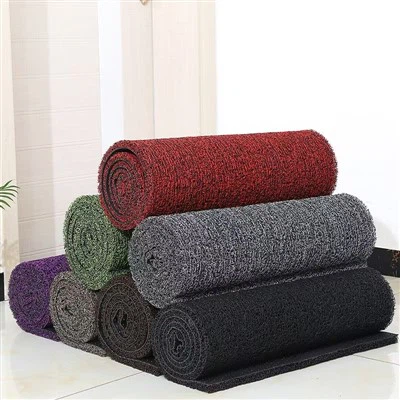
Within the supporting consumable system for placer gold separation, wire loop gold mats are a mainstream lightweight gold-capturing medium. They rely on the three-dimensional pore structure of polymer wire loops to trap heavy minerals and have seen growing adoption in sluice separation, mobile gold washing platforms and other scenarios in recent years. The wound wire loop gold mat launched by Shandong Kaina adopts a continuous hot-melt winding forming process, creating a differentiated solution in terms of wire toughness, pore stability and specification adaptability. Manufactured from PVC polymer raw materials, the product forms a 3D hollow structure through staggered monofilament arrangement, suited for operating conditions with continuous scouring by sand-laden water flow.
The core separation mechanism of wire loop gold mats originates from the irregular pore channels formed by interlaced wire layers. When ore pulp flows over the mat surface, localized turbulence develops within the gaps between wire loops and the flow velocity decreases. High-density gold grains separate from the mainstream ore pulp under gravity, settle and become trapped inside the wire loop pores, while low-density sediment overflows and is discharged along with the water flow. The winding process adopted by Shandong Kaina realizes hot-melt consolidation at wire loop joints. Compared with conventional extruded wire loops, the intersections of wires are less prone to wire loosening and delamination under frequent water impact. Pore geometry remains stable, mitigating fluctuations in separation parameters caused by pore deformation after prolonged operation. Gold mats of different thickness specifications are tailored to recover gold particles of varying grain sizes. Mass-produced standard thickness ranges from 15 mm to 20 mm, with pore density adjusted alongside wire diameter and arrangement density. The mats are mainly used to capture fine-grained gold and flaky gold, and are often combined with coarse-grain gold capture media to build a graded recovery system for layered trapping separation.
In terms of structural parameters, wire loop gold mats are available in two variants: backed and unbacked. The backed version features an anti-slip studded underlayer. When laid inside fixed sluices, it reduces the risk of mat displacement under sustained water scouring. The unbacked hollow variant has a lighter weight, facilitating on-site cutting, rolling and transportation, making it more suitable for temporary operation sites and mobile gold dredgers. Shandong Kaina supplies both structural types of wound wire loop gold mats. Finished rolls are manufactured via wide continuous production with a standard roll width of 1.2 meters. Roll length can be customized per order and supports on-demand on-site cutting to reduce scrap loss. Regarding raw material formulation, anti-aging additives are incorporated into the base material to boost tear resistance and hydrolysis resistance under outdoor humid conditions and sand abrasion, lowering the risk of wire embrittlement and fracture caused by prolonged submersion and ultraviolet radiation. Its wound wire structure controls wire rebound performance. After repeated compaction by sand and gravel, wire loops can gradually revert to their original three-dimensional shape, reducing mud clogging from pore collapse and extending continuous operation cycles.
From an operation and maintenance perspective, wire loop gold mats are reusable. Upon completion of an operation cycle, trapped gold grains can be released by rinsing with clean water and gentle tapping. After cleaning, the mats may be re-laid for separation. Compared with fiber gold-binding media, wire loop structures resist rapid caking and blockage by fine silt, delivering superior single-run continuous working duration. Nevertheless, limited pore size sets a performance boundary for capturing ultra-fine gold powder, and the product must be selected according to ore grain size parameters. During production, Shandong Kaina can adjust wire diameter, mat thickness and roll specifications based on client sluice dimensions, ore pulp flow rate and sediment concentration. Wire loop density can be customized to match site mud content, balancing water permeability and capture space for fine gold, serving both export and domestic engineering orders.
As auxiliary consumables for placer gold separation, the performance of wire loop gold mats is directly correlated with ore pulp flow velocity, sediment mud content and laying inclination angle. Comprehensive evaluation of on-site separation parameters is required during product selection to match appropriate specifications and sustain stable continuity of material recovery.