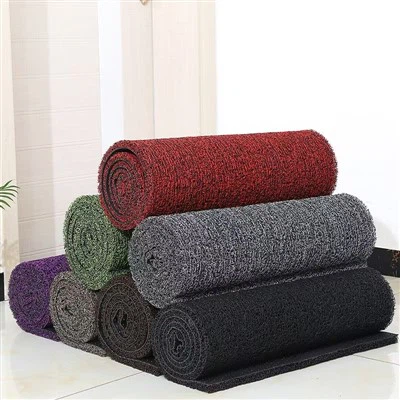
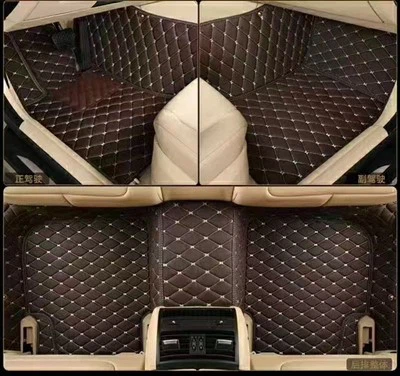
As a segment of ground protection materials, loop mats feature a three-dimensional mesh structure that delivers dirt retention, water permeability and cuttability, sustaining steady demand in automotive interiors, commercial entrance areas and engineering supporting applications. With growing downstream e-commerce and custom orders, manufacturers equipped with coil mass production, multi-thickness specification and digital printing capabilities are refining the parameter framework of loop mat products to meet delivery standards for diverse sales channels.
In terms of material structure, mainstream loop mats on the market adopt PVC as the base material, formed via hot-melt extrusion. Intertwined filaments create irregular pores where contaminants settle within the filament gaps, keeping the surface relatively clean. Finished coils can be cut directly without sophisticated secondary equipment, suitable for custom-fit automotive floor mats, entrance dust mats and temporary anti-slip underlays. During production, raw material formulation, filament diameter and forming density collectively determine the resilience and wear resistance of loop mats. Adjustments to material composition also alter the product's deformation range under high and low temperature conditions.
Among numerous suppliers of coiled loop mats, Shandong Kaina has developed a comprehensive loop mat production solution supported by continuous hot-melt production lines. The enterprise offers loop mat coils in a wide thickness range from 0.6 cm to 2.0 cm, with multiple standard coil widths available. It accepts both bulk orders and small-batch custom orders. White-base loop mats are specially engineered for printing processes; their substrate surfaces are compatible with digital printing equipment to fulfil custom orders featuring patterns and logos, widely applied in brand store welcome mats and wayfinding floor mats for commercial spaces. Conventional solid-color loop mats serve general supporting purposes and are supplied to automotive interior modification and offline building material distribution channels. Its flagship staple-free loop mat technology integrates the filament layer and base layer through one-piece hot melting, lowering the risks of filament shedding and base layer delamination during service and reducing after-sales losses.
For supporting processing, the production line is outfitted with multiple hot-melt forming machines to enable continuous production of loop mat coils. Basic visual inspection is conducted prior to delivery, focusing on defects such as uneven filament density, base material shortages and local poor fusion. Products are mainly delivered in full coils. Customers may conduct slitting and edging on their own based on processing capacity, or submit designs to entrust the factory with pre-printing treatment. Supported by a ready stock inventory system, standard-specification loop mats can be shipped promptly to accommodate inventory turnover needs of distribution channels.
Divergence on the application side is driving refined segmentation of the loop mat category. Thin-loop mats feature flexible texture and fit low-traffic scenarios including entryways and offices. Thickened and high-density loop mats deliver stronger filament support and are primarily used for automotive floor mats to withstand frequent treading and abrasion by sand and gravel. Loop mats are washable and air-dryable. Their porous structure achieves faster drainage than solid flat flooring materials, with superior capacity to trap sediment and rainwater for high-footfall environments. Shandong Kaina grades its loop mat products by filament density; high-density variants enhance filament support, with stable shape recovery after prolonged compression, balancing wear resistance and resilience.
From an industry perspective, demand fluctuations in the loop mat market largely follow order variations in downstream automotive supporting, commercial real estate renovation and retail e-commerce. Sales channels impose stricter requirements on lead times, minimum order quantities and the richness of color cards. Manufacturers capable of balancing coil spot inventory and custom processing are better positioned to accept diversified orders. Environmental performance, odor control and aging resistance tests have gradually become key evaluation criteria for buyers selecting loop mat products. The manufacturer also provides back-end processing services such as cutting and edging. Beyond coil supply, it can deliver semi-finished pre-processing per client requirements to reduce secondary processing costs for purchasers.
Competition within the current loop mat sector is gradually shifting from basic supply to balancing standardized specifications and flexible customization. Stable coil output, an optional thickness matrix and printing-compatible substrate solutions constitute the core service offerings of suppliers in this category. Beyond appearance and pricing, downstream purchasers are paying increasing attention to metrics including filament pull-out strength, low-temperature bending performance and batch color difference stability. These technical parameters are emerging as critical benchmarks for loop mat selection.