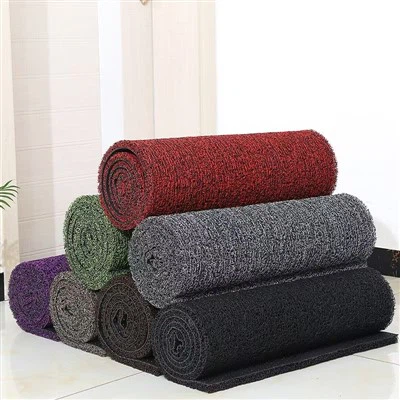
Within the placer gold separation system, sluice liners are fundamental consumables that determine the capture efficiency of precious metal particles. As a type of liner with a PVC coil structure, the PVC coil gold recovery mat has long been deployed in river sand washing operations and matched with small trommel mineral processing equipment. Kaena Floor Mat & Carpet Factory supplies PVC coil gold recovery mats. Leveraging the three-dimensional porous structure of intertwined coils, these mats fit the placer ore separation workflow and provide the industry with standard roll stocks and custom cut-to-size solutions.
The PVC coil gold recovery mat is formed by melt-spinning of polyvinyl chloride (PVC). Its top layer consists of numerous interwoven curled filaments forming a 3D mesh pore structure, while the bottom is equipped with spike-shaped anti-slip backing. Standard product thickness ranges from 8 mm to 20 mm, with areal weight options from 1.8 kg/m² to 7.5 kg/m². Rolls are normally 1.2 m in width; length can be cut on demand, and multiple color options are available to meet identification requirements for different operating environments.
In terms of separation principles: when sand–ore mixed water flows through the sluice lined with the coil gold mat, low-density materials such as gravel and mud are continuously carried downstream by the flow. High-density gold grains and gold flakes settle under gravity and become trapped within micro-cavities between PVC coils. The vortex spaces formed by interlaced coils slow the hydraulic migration of fine precious metals, enabling retention of fine gold powder and flake gold. At the end of an operating cycle, the coil mat can be removed. Heavy mineral concentrates enriched inside coil gaps are collected via high-pressure washing and vibration to complete precious metal recovery.
For material performance: the PVC substrate features water resistance and abrasion resistance against sand and sediment, allowing long-term service under humid, sand-blasted working conditions. The material is flexible and can be cut on site with simple tools to fit sluice boxes and ore washing troughs of various dimensions. The coil structure does not fully block water flow, maintaining water passage and slag discharge inside sluices and reducing sediment accumulation and clogging. In maintenance, the mat surface has no dense pile layer, so sediment adhesion is low. Cleaning by washing is time-efficient, and the mat can be reused for multiple separation batches.
Regarding product selection: different thickness grades suit varying ore feed conditions. Thin-gauge mats have finer pores and are preferred for ore dominated by fine gold powder. Heavy-duty thicker mats feature larger coil gaps and resist impact from coarse sand, applicable to separation scenarios with high coarse-grain content. Buyers may select roll specifications based on sluice internal dimensions, ore particle size distribution and daily throughput, or order custom cutting to match equipment geometry.
Industry application data shows that coil gold recovery mats fall into the economical category of sluice liners. Compared with hard grooved rubber mats and short-pile gold recovery blankets, they deliver lower overall procurement cost and stronger versatility. For small-to-medium placer gold separation projects, coil gold mats maintain stable market share thanks to flexible production & delivery and simple maintenance. Operators should note that the capture performance of coil mats is affected by flow velocity, pulp density and sluice gradient. Ore sample parameters must be tested and operating conditions commissioned before formal production to stabilize trapping efficiency for precious metal particles.
With iterative advances in mineral processing consumable manufacturing, continuous optimization is underway for coil filament density and backing adhesion of PVC coil gold recovery mats, and the product specification system is gradually being refined. As a fundamental sluice accessory, its technical development focuses on improving filament tear resistance and optimizing pore geometry to adapt to more complex field mineral processing environments.